Why open-plan rooms need a different cooling plan
An open-plan lounge, dining room and kitchen can look simple from the outside, but the cooling load is usually not simple at all. One unit may need to move air across a long distance, past doorways, through a passage and then back again, while still handling people, sunlight and appliances in the same space.
That is why a quick room-size guess often falls short. In Mbombela and White River, where summer heat and humidity can hold through the afternoon, a unit that seems fine on paper may struggle once the space fills with warm air from the kitchen. In Klerksdorp and Potchefstroom, strong afternoon sun and dusty conditions can also change how hard the unit works.
For open-plan cooling, we look at the whole area, not just one wall. We also check where the warm pockets sit, because a living area with high glass frontage can need a different approach from a tiled family room with fewer windows.
Airflow has to travel, not just blow
A wall split does not cool every corner equally. It throws air in one direction, so the position of the indoor unit matters. If it faces a long room with no clear return path, the cool air can stall near one end and leave the kitchen or seating area uneven.
When planning an open-plan layout, we look for a placement that gives the best throw across the room and avoids blowing directly onto a dining table or sofa. In some cases a cassette fits better because it distributes air in four directions from the ceiling. In other cases two smaller wall splits work better than one larger unit, especially where the room bends around an island counter or a stair opening.
- Keep supply air clear of bulkheads, curtains and high cupboards.
- Allow enough return air so the unit is not fighting its own flow.
- Check for ceiling fans, which can help or disturb the air pattern depending on where they sit.
- Avoid placing the unit above a hot appliance line where steam and grease will affect it.
The aim is steady movement, not a cold blast in one spot and warm pockets everywhere else.
Ceiling height changes the size of the job
High ceilings are common in modern homes, restaurants and office spaces, and they change the amount of air that needs cooling. A standard ceiling may be around 2.4 m, but once the height climbs to 3 m or more, the air volume increases sharply. That extra volume means the unit has more air to condition before the room feels right.
In taller spaces, we also look at stratification. Warm air rises, so the top of the room can stay hot while the lower area feels only partly cooled. This is one reason a correctly positioned cassette or a higher-capacity wall unit may work better than a small split that was chosen only by floor area.
If the room has exposed trusses, mezzanine areas or raised sections, the ceiling shape must be included in the site assessment. A simple square metre figure does not show how much heat will settle above head height.
Kitchen heat can overpower a living area
An open-plan kitchen adds more than just a stove. Ovens, kettles, fridges and dishwashers all release heat into the same shared room. Even normal cooking can change the temperature by several degrees in a short time, especially when the space is closed off from through-draughts.
In homes across the Lowveld, this is often the reason a unit seems underpowered in the late afternoon. The aircon may be doing its job, but the kitchen keeps feeding heat back into the room. If the space is used for regular cooking, we often advise a stronger unit, better air distribution, or a layout that keeps the kitchen zone partly separate from the main lounge area.
For heavy cooking areas or home business kitchens, regular cleaning matters as well. Grease and fine dust can build up on filters and coils, and then the unit uses more electricity for the same result. That is a costly cycle, especially during load-shedding recoveries when systems are switched off and on more often.
Trade price options for homes, guest spaces and small business areas
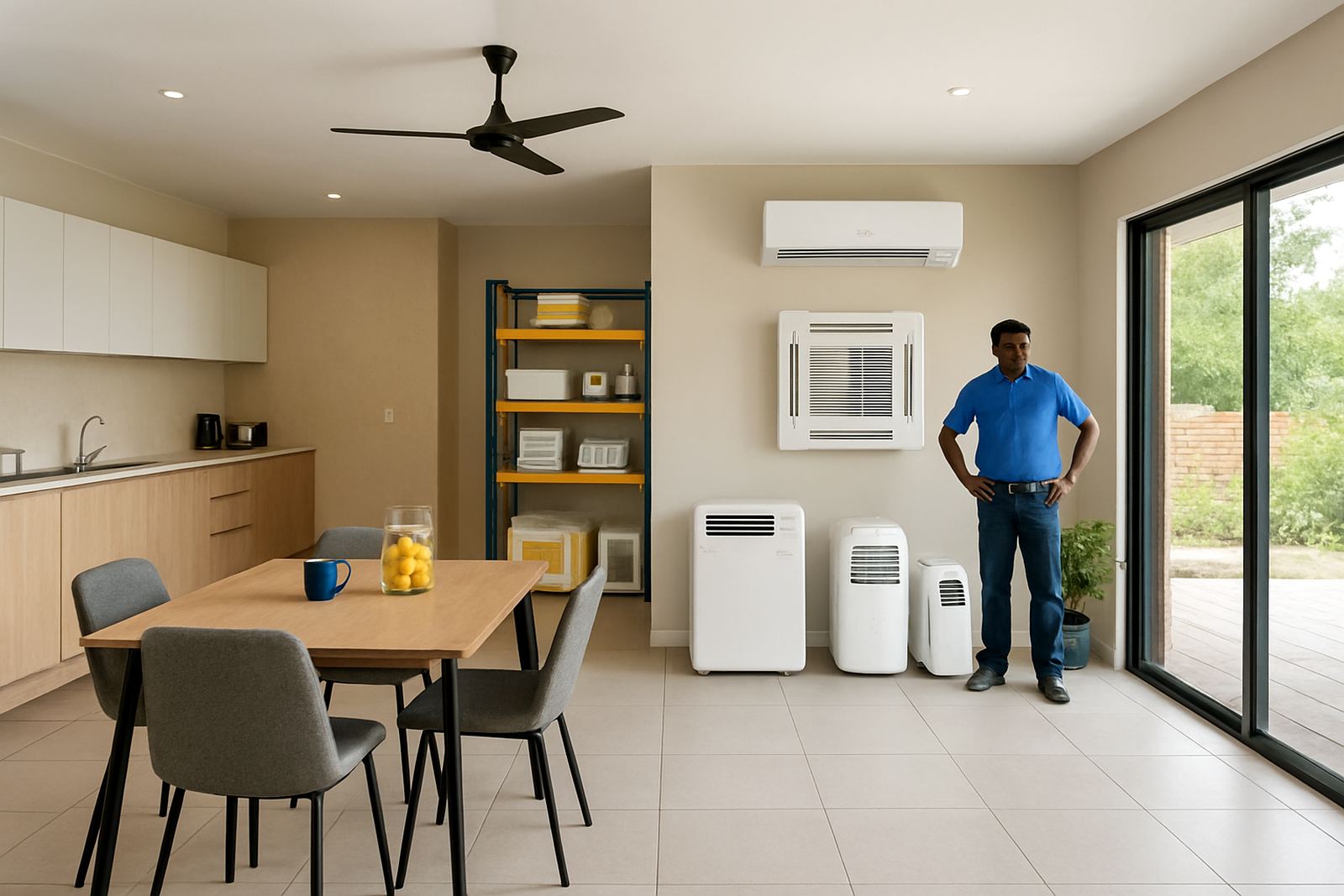
Aircon Warehouse carries wall splits, cassettes and portable units at trade prices, which gives customers a few practical choices for open-plan cooling. The right option depends on how the room is used, how often it runs, and whether the space is a home lounge, a rental unit, a clinic waiting area or a small showroom.
Portable units can help in temporary or flexible spaces, but they are not the first choice for large open-plan rooms with high heat gain. Wall splits are often the main answer for living areas, while cassettes suit rooms with a more central ceiling position and a cleaner air throw pattern. For some homes in Rustenburg and Klerksdorp, two modest units can give better comfort than one oversized unit placed in the wrong spot.
- New installations for homes and light business spaces.
- Replacement units when an older system no longer copes with the room load.
- Cassette fitment for central open areas and higher ceilings.
- Portable setup where a fixed installation is not practical.
Our team can also advise on commissioning, so the system starts up correctly and performs as it should from the first day.
A local example from Mbombela to the North West
Take a family room in Mbombela with a kitchen on one side, a dining table in the centre and a sliding door to the patio. On paper it may look like one medium room, but in practice it has direct sun, cooking heat, a tall ceiling and air that escapes each time the door opens. A small wall unit mounted in the wrong corner will fight that load every day.
In a case like this, we would first assess the room and look at the path of the airflow. If the ceiling height is standard and the room is not too long, a well-placed split may be enough. If the room is broader or the ceiling is higher, a cassette or a second unit might give better balance. In Klerksdorp and Potchefstroom, the same logic applies, though dust and summer heat cycles often mean the filters need checking more often.
Good cooling starts with the room, not the machine. Once the layout is understood, the equipment choice becomes much clearer and the running cost is usually more sensible too.
What to ask before you choose a unit
Before you buy for an open-plan space, ask the installer to look at the full room rather than a single wall. A proper site assessment should cover sunlight, ceiling height, kitchen placement, doorway positions and how the space is used during the hottest part of the day. That is the difference between a unit that just turns on and one that actually holds the room at a usable temperature.
We work from Mbombela, with coverage in White River, Hazyview, Klerksdorp, Potchefstroom and Rustenburg. If you need a new installation, a replacement unit, gas top-ups, scheduled servicing or fault finding, it helps to deal with a team that understands local heat, municipal water quality, coastal humidity pockets inland and the reality of power interruptions.
For open-plan cooling, the answer is usually in the details. Get the airflow right, account for the ceiling, and never underestimate what the kitchen is adding to the room.
Keeping the space comfortable after installation
Once the unit is in, upkeep matters. Filters should be cleaned regularly, especially in homes with pets, schools nearby or roads that carry dust. Deep cleaning helps remove build-up from the indoor coil and keeps the system moving air properly. If the room is used daily, scheduled servicing is worth it before summer starts.
We also recommend checking the unit after any layout change. A new island, extra curtains or a closed-in patio can alter airflow enough to make the room feel warmer than before. Small changes add up.
Open-plan cooling works best when the system is matched to the room and maintained properly. That is where comfort stays steady through the hottest months.