What a condensate pump does on an aircon install
A condensate pump is a small drainage pump used to lift or move the water that forms on an air-conditioner indoor unit. Every wall split, cassette or similar unit produces condensation while it is cooling, and that water must leave the unit safely. When the pipe cannot run downhill all the way to a drain, the pump takes over and pushes the water to a suitable outlet.
In Mbombela, White River, Hazyview, Klerksdorp and Potchefstroom we see this often in buildings with high ceilings, tiled interiors, short outside wall runs, or renovations where the drain point is simply not in the right place. A good pump keeps the installation neat and avoids water dripping back into ceilings, ceilings boards, or along the wall. It also helps on sites where the owner wants the indoor unit positioned for better air throw, even if the natural fall is poor.
Pump sizes, lift height and flow to look for
Condensate pumps come in compact, medium and higher-capacity options. The right choice depends on the indoor unit size, the amount of water expected in humid weather, and the height and distance the water must travel. Some units sit inside the wall split casing or above a ceiling, while others are fitted as separate pumps near the drain tray. For most aircon jobs, the pump only needs to move clean condensate water, not waste water or dirty water.
As a rule, check the following before ordering:
- Maximum lift height in metres, especially if the drain must rise to a ceiling void or over a beam
- Flow rate in litres per hour, matched to the indoor unit capacity
- Tank or sensor style, depending on how often the unit will run
- Noise level, important in bedrooms, consulting rooms and small offices
- Physical size, so it fits above the ceiling or inside the wall split housing
- Alarm or cut-out function, for protection if the drain line blocks
For single wall splits, a compact pump is often enough. For cassettes in shops, churches and boardrooms, a slightly stronger pump is usually better because the water load can be higher during long cooling periods.
Where a condensate pump suits best
These pumps are useful anywhere gravity drainage is not possible or would be too costly to build. That includes top-floor offices, garages converted into rooms, shop fronts with glass walls, and older homes where the indoor unit must be placed away from an outside wall. They are also handy on tight commercial sites where there is no direct route to a nearby drain without cutting through finished ceilings. In Rustenburg and Klerksdorp, we often supply them for premises where the aircon must sit on an internal wall and the drain has to travel across the ceiling void.
Typical applications include:
- Wall split systems in bedrooms, lounges and offices
- Cassette units in retail spaces and meeting rooms
- Portable setups where a fixed drain route has been created
- Replacement units when the old drain line no longer falls correctly
If the site has frequent load-shedding, it is worth noting that the pump only works while it has power. The aircon itself will stop during an outage and the condensate flow drops, but when power returns the pump should restart cleanly and move any standing water without delay.
Installation details, power needs and drain routing
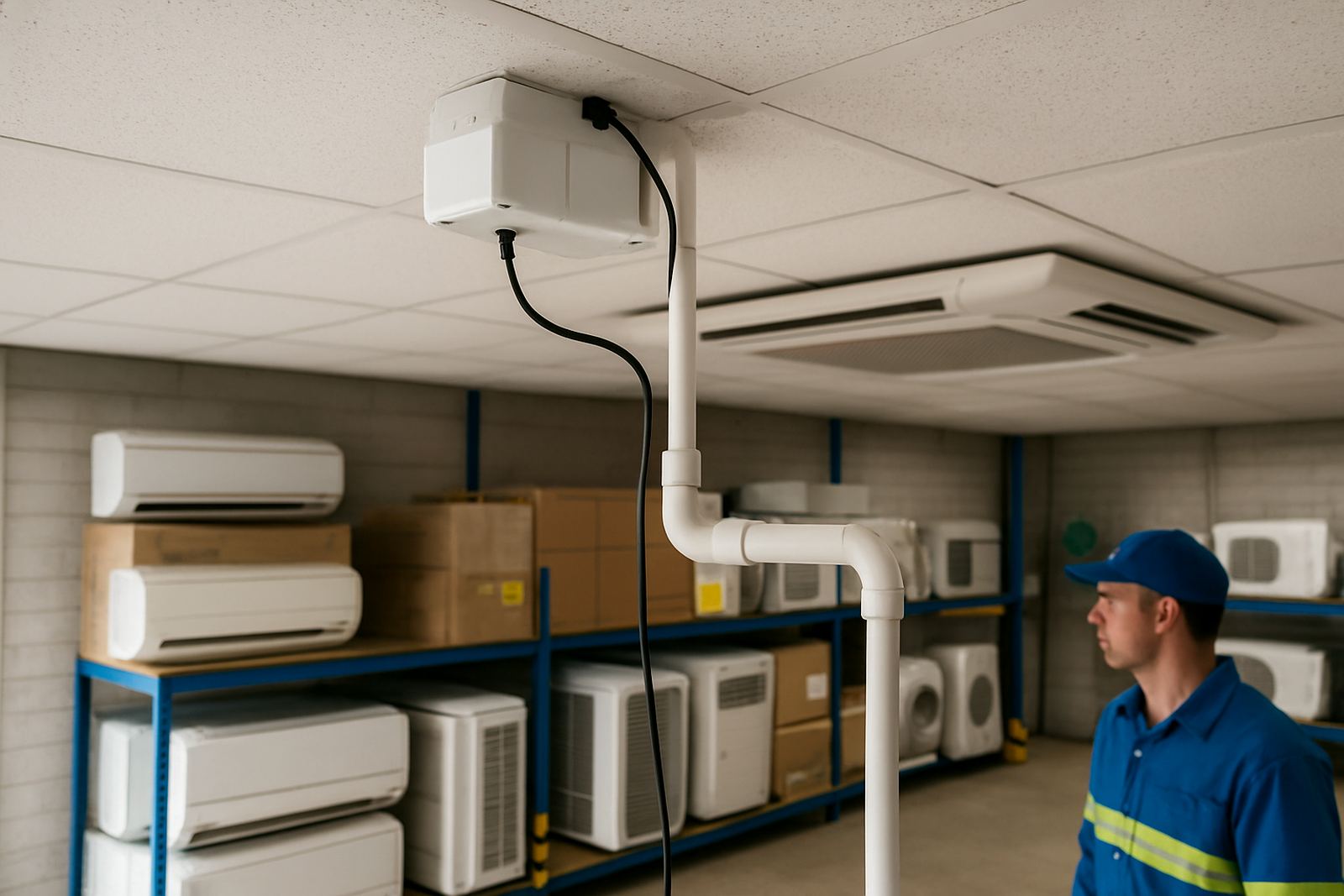
A condensate pump is usually wired into the installation so it runs with the indoor unit or responds to a float sensor. It does not need a gas connection. The refrigerant circuit stays separate and must still be installed, tested and commissioned by a technician who knows the unit size and pipe lengths. For a tidy result, the pump should be mounted level, with the inlet line secure and the outlet line kept clear of kinks, tight bends and unnecessary joints.
We recommend checking these points during installation:
- Access for future service, not hidden where nobody can reach it
- Safe power supply from the indoor unit circuit or a suitable nearby feed
- Proper insulation on the drain line if condensation could form outside the pipe
- Non-return protection where backflow may be a problem
- Correct fall from the tray to the pump inlet, even if the outlet has to rise
On coastal or humid sites, a well-supported drain line matters as much as the pump itself. If the outlet hose sags, traps air, or runs through a dusty ceiling, the system can start to overflow over time. That is why site assessment is important before fitment.
Care, servicing and signs the pump needs attention
Condensate pumps do not need heavy servicing, but they do need regular checks. Dust, algae, ceiling dirt and small debris can collect in the tray or float chamber, especially where the aircon runs every day. A blocked drain is usually the first sign that the pump or its line needs cleaning. If the pump starts to hum but water does not move, or if the unit trips on overflow, it should be inspected quickly.
Good maintenance includes:
- Cleaning the pump reservoir and float area during scheduled servicing
- Checking the outlet line for kinks, pinches or blocked ends
- Testing the float switch and alarm, if fitted
- Making sure the pump is still secure after ceiling work or repainting
- Looking for slow leaks around joints and connections
With regular servicing, a pump can last well, but the best protection is simple: keep the drain line clean and do not ignore small drips. A minor blockage today can become ceiling damage tomorrow, and that gets expensive quickly.
What to check before you order one
Before buying a condensate pump, take a few site details. Measure the vertical lift needed from the indoor drain point to the discharge point. Check how far the water must travel horizontally as well, because distance affects performance. Confirm whether the pump will be hidden above a ceiling, fixed beside the unit, or mounted in a serviceable position. Also look at the type of unit being installed, since a cassette and a wall split do not always have the same drain arrangement.
It also helps to confirm the following:
- Indoor unit capacity and expected condensate volume
- Available electrical point or indoor unit connection method
- Discharge location, such as a gully, external drain or soakaway
- Whether the site has dust, humidity or salt air that may affect service life
- Any building rules for ceiling access, pipe routes or external discharge
If you are replacing an older pump, bring the model details, pipe size and any fault history. That saves time and helps match the new unit correctly. At Aircon Warehouse we work with trade buyers, installers and owners across Mbombela, the Lowveld and North West, and we can help match the pump to the aircon job so the drainage works the first time.
Key facts
| Product type | Condensate drainage pump for air-conditioner indoor units |
|---|---|
| Use case | Lifts and moves condensate where gravity drainage cannot be used |
| Typical lift | Compact to medium lift options, depending on model |
| Typical flow | Sized to suit small wall splits through to larger cassette units |
| Power | Mains-powered or indoor unit linked, model dependent |
| Common fitment | Wall splits, cassettes, offices, homes and retail premises |