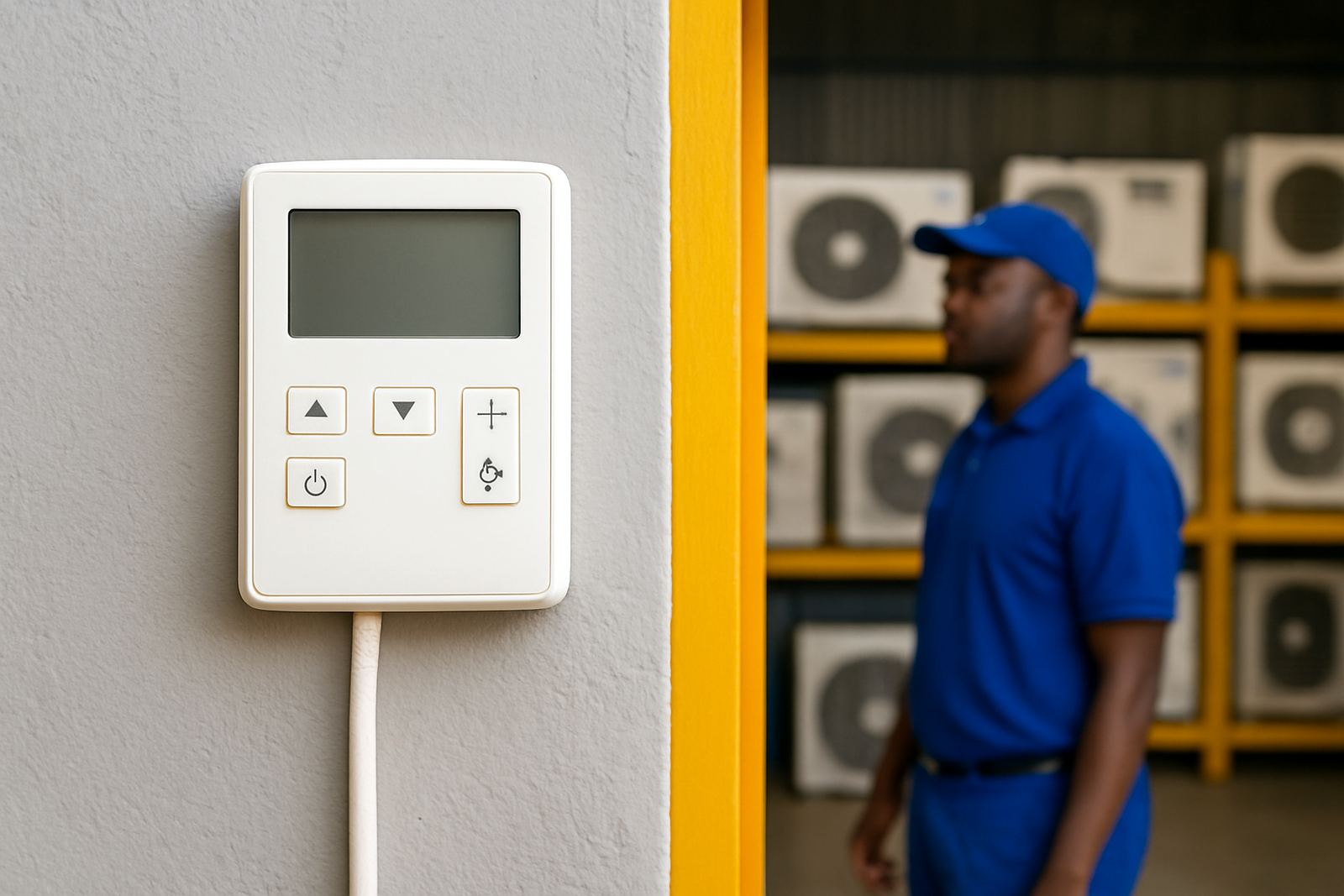
What a wired controller does on a fixed air-conditioning setup
A wired controller is a wall-mounted control point linked directly to the indoor unit. Instead of relying on a hand-held remote, the user changes temperature, fan speed, operating mode and timer settings from a fixed position on the wall. That makes sense in offices, consulting rooms, staff areas, boardrooms and homes where the unit is used every day.
On a practical level it keeps control in one place. The controller is harder to misplace, easier for staff to learn and better for shared spaces where more than one person may need access. In a busy workplace around Mbombela, White River, Hazyview or Klerksdorp, that can save a lot of time. It also suits areas where daily use is steady and you want the settings to remain simple.
Most wired controllers are used with fixed split systems and some cassette installations. They are not a separate cooling unit on their own, just the interface that tells the air-conditioner what to do. If your unit is already installed, the controller must match the make and control type of that system for proper communication and fault-free operation.
Controller options, display styles and control functions
Wired controllers come in a few practical layouts, from compact units with a basic display to larger models with more detailed menu settings. The choice usually depends on how much control you want on the wall and whether the unit is used by one person or several users. Some have simple up and down temperature buttons, while others include scheduling, child lock functions and error display codes.
- Basic temperature and mode control for straightforward daily use
- Timer and weekly scheduling on selected models
- Fan speed selection for low, medium, high and auto operation
- Set point lock or button lock for shared areas
- Error code display for quicker fault checking
- Backlit screen for dim rooms and after-hours use
For offices in Rustenburg or Potchefstroom where the unit runs during business hours, scheduling can help keep usage tidy. In homes and guest rooms, a simpler controller may be enough. The right option depends on the indoor unit and how often people will change settings.
Where a wired controller works best in the Lowveld and North West
This product suits places where the air-conditioner is part of daily routine, not just an occasional comfort feature. It works well in reception areas, salons, clinics, small retail spaces, control rooms, classrooms and private homes. In the Lowveld, where cooling demand climbs fast in summer and dust can be a factor, a fixed wall controller is convenient because it stays in one known spot.
In Klerksdorp and other North West towns, users often want simple control that staff can understand quickly. A wired controller helps with that. It is also useful where hand-held remotes tend to go missing, get damaged, or are shared between more than one person. If the indoor unit is installed high on a wall or in a cassette ceiling set-up, the wired controller brings the operating point down to eye level for easy access.
For commercial properties, it is worth planning the controller position carefully so it is not exposed to direct sun, steam, or vibration. That matters in places with strong afternoon heat or damp conditions near coastal deliveries and stored stock, even if the site itself is inland. Simple positioning makes the reading more accurate and the daily use less frustrating.
Installation needs, wiring and matching to the indoor unit
A wired controller must be installed correctly to communicate with the air-conditioner control board. That means proper cabling, correct polarity where required, and a controller that is compatible with the indoor unit. It is not usually a plug-and-play item for a mixed system, so checking the model and control protocol before ordering is essential.
Installation normally involves mounting the controller on an internal wall, running the communication cable neatly back to the unit and testing the response at every main setting. If the system is a new installation, this is the best time to include the controller so the wall finish and cable route are neat. For replacement units or upgrades, the existing wiring must be assessed first. In some older sites the cable route is fine, in others it needs to be redone for a cleaner and safer result.
- Confirm the indoor unit model and controller compatibility before supply
- Check cable length and route from the controller to the indoor unit
- Allow for power isolation during installation and commissioning
- Test cooling, heating, fan, timer and fault display after fitment
- Use a qualified installer so wiring and terminal connections are secure
For sites in Mbombela, White River, Hazyview, Klerksdorp, Potchefstroom and Rustenburg, proper commissioning is important because a controller that is wired badly can give wrong readings or unreliable operation. That leads to call-backs nobody wants.
Power, electrical supply and what the controller does not need
The wired controller itself uses very little power, but it must be connected to a compatible indoor unit and the full system must have the correct electrical supply. It does not cool the room on its own and it does not replace the need for proper circuit protection, isolators and cabling sized for the actual air-conditioner. The controller is only part of the control side of the installation.
If the system runs during load-shedding, the controller still needs the main unit to have stable power when the supply returns. On sites with generator or inverter backup, the restart behaviour of the indoor and outdoor units should be checked. Some systems remember the last setting, while others need manual restart. That is worth confirming before the unit is fitted, especially in offices that cannot afford confusion after an outage.
There is no gas charge involved in fitting the controller itself. Refrigerant gas is only relevant if the installation also involves a new system, a replacement unit or a fault that has caused a leak. In those cases the aircon must be pressure tested, evacuated and charged to the correct specification, not guessed at. A controller install should never be used as a shortcut around proper system setup.
Care, servicing and signs the controller or system needs attention
A wired controller needs very little maintenance, but the system around it still needs attention. Keep the screen clean, avoid water spray and do not press the buttons with wet hands. If the controller is in a busy area, check that the wall plate stays secure and that the cable entry is not loose. Small physical issues are easy to fix early and can prevent bigger trouble later.
If the display is blank, the buttons are slow to respond or the air-conditioner is not reacting to settings, the fault may be in the controller, the wiring, or the indoor unit board. It could also be linked to power interruptions or moisture in the control circuit. In dusty commercial sites or coastal humidity, routine servicing helps reduce these problems. Deep cleaning of the unit, fault finding and scheduled servicing all support better controller performance because the whole system works cleaner and more predictably.
If the room temperature seems wrong even though the controller is set correctly, check the controller position. It should not be above a heat source, in direct sun or near a doorway where hot air rushes past. That small mistake can cause poor comfort and unnecessary complaints from staff or family members.
What to confirm before you order a wired controller
Before ordering, confirm the make and model of the indoor unit, the controller style required and whether the system uses a standard wall controller or a specialised control interface. If you are replacing an existing controller, send a photo of the old unit and the current indoor unit label if possible. That makes matching much easier and avoids delays.
- Indoor unit model and serial details
- Whether the system is wall split or cassette type
- Controller function needed, basic or programmable
- Cable length available between controller and indoor unit
- Whether it is a new fitment or a replacement controller
- Any power backup, timer or access control requirement on site
For trade buyers and site managers, it also helps to note the branch area and the end use of the room. A boardroom in Rustenburg does not need the same setup as a small staff room in Hazyview. The more detail you give upfront, the smoother the supply and installation process will be.
Key facts
| Product type | Wall-mounted wired controller for compatible air-conditioners |
|---|---|
| Use | Fixed control point for daily temperature, mode and fan settings |
| Compatible systems | Selected split and cassette indoor units |
| Mounting | Internal wall mount with communication cable to indoor unit |
| Power use | Low control-power draw from the connected system |
| Typical application | Homes, offices, clinics, retail spaces and shared rooms |